“We can’t get the funding because we can’t get the evidence” – Supporting the Scottish voluntary sector’s work with Black and racially minoritised communities
In this blog, Lucien Staddon Foster reflects on the role data plays in creating challenges and barriers for voluntary sector organisations working with Black and racially minoritised communities in Scotland. In 2025, Lucien Staddon Foster and Sholen Macpherson, supported by the Jane Hatfield Award, designed and delivered a research project to better understand this issue and directly address key evidence gaps affecting some of Scotland’s largest equality charities.
It is no secret that Scotland’s voluntary sector is under immense pressure. Organisations are constantly having to do more with less, with their services expected to fill critical gaps in public services, all whilst contending with widening inequality, unpredictable funding arrangements and faltering community cohesion.
However, for organisations working extensively with Black and racially minoritised communities, this is only part of the problem, as they also face unique challenges in the funding landscape. For example, in an effort to maximise the reach and impact of voluntary sector initiatives, some funders prefer to support projects and organisations that serve as many people as possible, while others require organisations to provide a wealth of evidence to justify why a programme is needed, or why a particular initiative is the most effective course of action. On paper, this helps funders generate the best value for money possible, but in reality, it creates barriers to funding based on the people the organisations work with and the evidence they can provide.
While many voluntary sector organisations already host a wealth of evidence through lived experience of inequality, discrimination and disadvantage, this is often undervalued compared to statistical evidence. This presents a significant challenge, as the quality and availability of data on the experiences of Black and racially minoritised communities in Scotland is incredibly poor – so much so that:
The United Nations’ Committee on the International Convention on the Elimination of All Forms of Racial Discrimination called for Scotland to “systematically collect and publish comparable statistics on the enjoyment of rights by members of ethnic minorities in all fields of life, in order to identify ethnic disparities, to inform policy decisions aimed at eliminating racial discrimination and to evaluate their impact.” And “improve the collection of data on the situation of ethnic minorities facing multiple and intersecting forms of discrimination.”
However, this is not well recognised in the funding landscape, which expects organisations to provide a quality and quantity of evidence that either doesn’t exist in Scotland or is rendered inaccessible by institutional barriers, skill gaps and resource constraints.
When speaking with voluntary sector organisations working with Black and racially minoritised communities, we heard that:
“The third sector funding landscape, it’s all a little bit backwards, they want evidence that doesn’t exist and then don’t make the most of the evidence that does exist”
In recognition of these barriers, Lucien Staddon Foster and Sholen Macpherson, two race equality researchers based in Glasgow, designed and delivered an initiative to support voluntary sector organisations to access and use data from Scotland’s 2022 Census in their work.
As researchers and campaigners for racial justice, we understood that Scottish Census data could be an incredibly powerful tool for exposing systemic inequality, identifying the need for targeted services, and evidencing community needs. We, therefore, wanted to leverage the rare opportunity offered by the Census to directly support voluntary sector organisations working with Black and racially minoritised groups in Scotland.
Supported by the Jane Hatfield Award 2025, we partnered with four charities working to protect and promote the rights of minority ethnic groups across Scotland.
Scotland’s four regional equality councils provide a range of services to support and advocate for minority ethnic groups in Scotland, including advice services, working with the public sector to tackle inequality, and promoting community cohesion in their local areas.
Our goals were simple:
- To understand how the organisations used data in their work, the barriers they encountered, and how the quality and availability of statistics impacted their organisations and their mission
- To help address evidence gaps through targeted analysis of Scotland’s 2022 Census, tailored to the needs and priorities of our partner organisations
Background
This project was supported by the Jane Hatfield Award 2025, an annual grant given to a team of young researchers from Black and racially minoritised backgrounds to investigate issues or topics related to community, social action and/or social justice.
The Award was launched in 2022 by the Institute for Voluntary Action Research (IVAR), in partnership with The Ubele Initiative CIC, and was named in memory and celebration of Jane Hatfield: Trustee and Chair of IVAR from 2006 to 2021.
This initiative was designed and delivered by Lucien Staddon Foster and Sholen Macpherson, two race equality researchers specialising in using ethnicity-disaggregated data to identify and expose structural and institutional racism in Scotland. Outside of the Jane Hatfield Award, which was completed independently, Lucien and Sholen work for the Scottish anti-racism charity, the Coalition for Racial Equality and Rights (CRER).

Sholen Macpherson
https://www.linkedin.com/in/sholenm/
Lucien Staddon Foster
https://www.linkedin.com/in/lucienstaddonfoster/
Data-led approaches in Scotland’s third sector
In preparing for this project, it was important to understand how voluntary sector organisations use – or would like to use – statistical evidence to support their work with Black and racially minoritised communities. We sat down with Scotland’s four regional equality councils to discuss the role data plays in their work.
While each organisation strongly recognised the value of statistical evidence for monitoring inequality, providing evidence to funders, and evaluating the impact of services, the approaches taken varied considerably.
Some organisations routinely use statistics for policy advocacy and training materials, sometimes with full-time staff dedicated to producing and collating statistics disaggregated by age, sex, ethnicity, and immigration status.
“[Equalities data] enables us to identify gaps in services, and examine how we can address these gaps and reduce or eliminate any inequalities.”
“When delivering training, we cite statistics, data and evidence to reinforce arguments when we’re talking about equalities and anti-racism more broadly.”
“The gaps [in service provision] we’re seeing aren’t random – they’re rooted in racism, exclusion, systemic issues, and we need the data to help us evidence that.”
Others were able to generate their own data when delivering services, which helps them evaluate the reach and impact of their work and provide advice to government, funders and other charities about emerging demands.
“The data we gather enables us to gauge how diverse our service users are and how we can improve on engaging with the wider community. At the moment, we collect data on ethnicity, gender, age and reason for contact.”
“We have a list on our internal database of the most commonly requested languages for translation and interpretation, which allows us to see what we need to improve our services, as well as how we advise external organisations on what community demands are.”
“Our access to the community can be sporadic. We don’t know who else is out there or what’s being missed. One day, you would be dealing with someone who has a completely singular experience compared to someone from the same community, and then the next day or month, you’d never see anyone from the community again. It would be too hard for us to create a bigger picture from that information, but with data, you can actually depict that.”
However, for some organisations, a lack of time, skills and resources significantly limited their capacity to utilise statistical evidence, often causing problems in the funding landscape.
Challenges and barriers
While multiple organisations cited resource, time and skill constraints as barriers to making full use of statistical evidence, our conversations emphasised the larger issue in Scotland. More often than not, publicly available data simply isn’t good enough.
For example, many official and administrative statistics in Scotland are not disaggregated by ethnicity when analysed or published by public bodies. When they are, they often combine all minority ethnic groups into a single category or do not provide any regional breakdowns. This can obscure inequalities between Black and racially minoritised communities and make it difficult for organisations to evidence local or community-specific needs for their services.
“The data is at a national level, so trying to get data out of the system for specific regions or areas is really, really difficult.”
“The biggest barrier, actually, is the lack of data at a granular
level”
“There’s a real lack of data, especially regional data, but then the ability to go and fix this, or to go in and deliver projects, is so limited. You’re stuck in a cycle.”
Not only does this poor-quality data impact how organisations perform in grant applications, some felt that it also undermines trust and confidence in public institutions and contributes to frustration within Black and racially minoritised groups.
“We’ve had cases where organisations feel erased by the data – it doesn’t reflect their existence.”
For others, this fed into patterns of funders and policymakers using data as an excuse for not taking action, either by placing an unreasonably high burden of proof on organisations to highlight the need for services, or by weaponising statistics with cherry-picked findings.
“Not being able to have that strong dataset or evidence to back up our arguments has been a big barrier for us, especially when talking to people in the room who haven’t had lived experience of racism.”
We also found that even when high-quality data was available, organisations felt that the voluntary sector was rarely empowered to use it.
For example, some felt they lacked the time to scour Scotland’s patchy data landscape to find what they needed, or the capacity to develop the technical skills to make the most of it. This contributed to a lack of confidence in using statistics in their work and a fear of making mistakes.
“Because [statistical analysis] isn’t my primary skill set – and even just from a time point of view – I would feel overwhelmed by Census figures and would want reassurance that I’m using them correctly.”
“Some of the groups we support are doing incredible work, but they’re nervous about using data because they think they’ll get it wrong or it will be challenged.”
This issue is especially prominent when working with Scotland’s 2022 Census, which introduced a new approach to publishing Census data and related analysis. Historically, the general public could access Census data only after it was released in a government publication or research paper; however, the 2022 Census has opted for fewer official publications and introduced a Flexible Table Builder instead. This allows people and organisations to draw their own analysis from the Census, democratising access but introducing skill and capacity barriers to its use. As a result, using the Census can be time- and resource-intensive, rendering it inaccessible to smaller voluntary sector organisations.
Again, the funding landscape itself seemed to feed into this, as during our discussions, it became clear that many funding arrangements prioritised service delivery over all else. Without ring-fenced resources for organisational development, charities are often discouraged from spending time and resources building staff capacity and internal systems to use in their work, even though funders demand greater quantities of evidence to demonstrate the need for their services. These experiences evidence the needs for funders to provide dedicated resource for capacity and development activities in their funding decision-making.
How we’re helping to address this
While it is important to capture the challenges and barriers facing voluntary sector organisations, understanding the problem is only part of the picture. Therefore, we set out to directly address some of the key evidence gaps affecting our partner organisations, lending our analytical skills and extensive knowledge of Scotland’s data landscape to directly support their work.
Based on a series of consultation meetings, we identified how data from Scotland’s 2022 Census might address some of the needs and priorities of each organisation, addressing data gaps, providing statistical evidence to support their campaigns, and helping them quantitatively understand the characteristics and circumstances of the communities they work with.
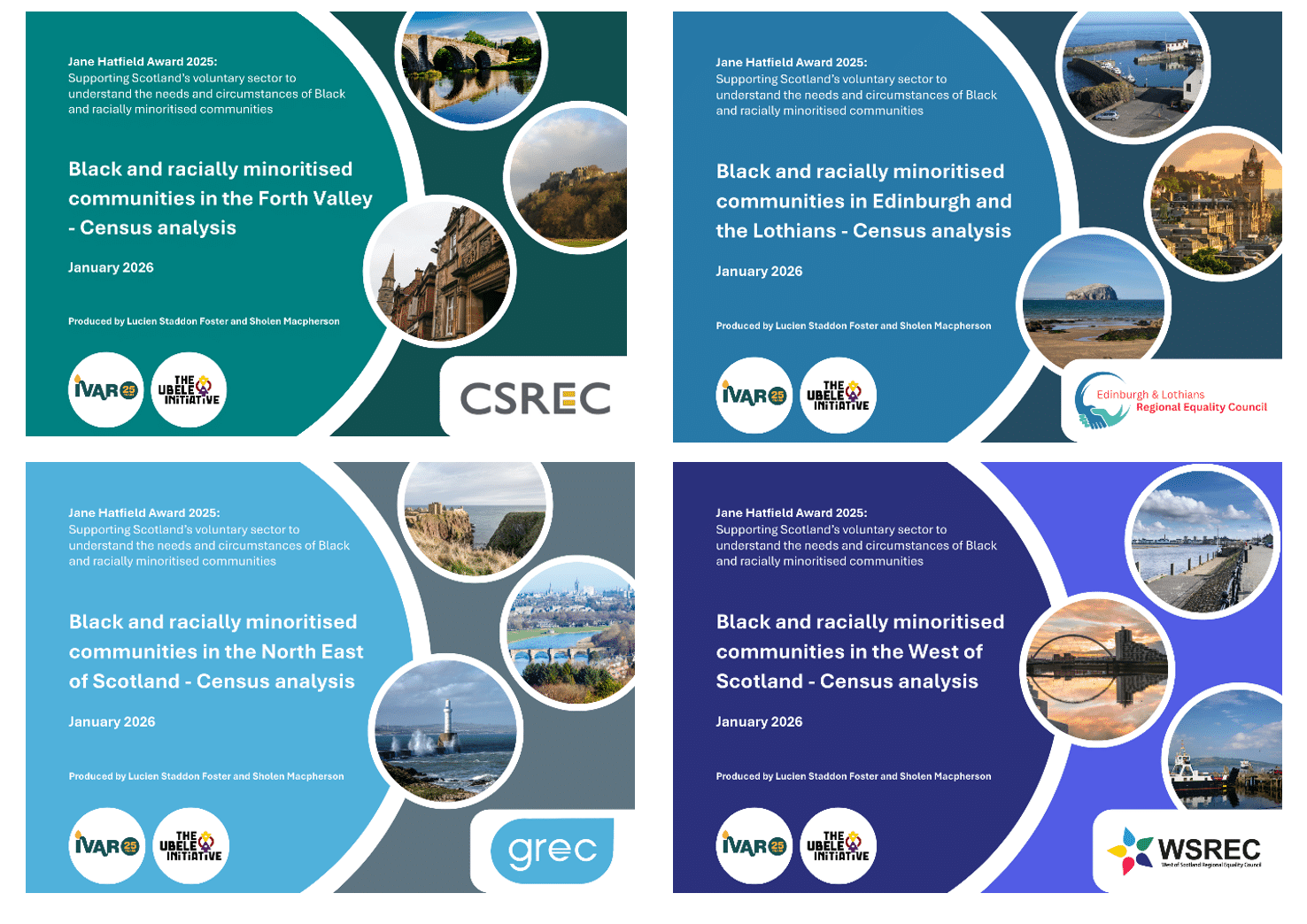
This informed the creation of four bespoke research reports, each tailored to the regional context and organisational priorities of our partners:
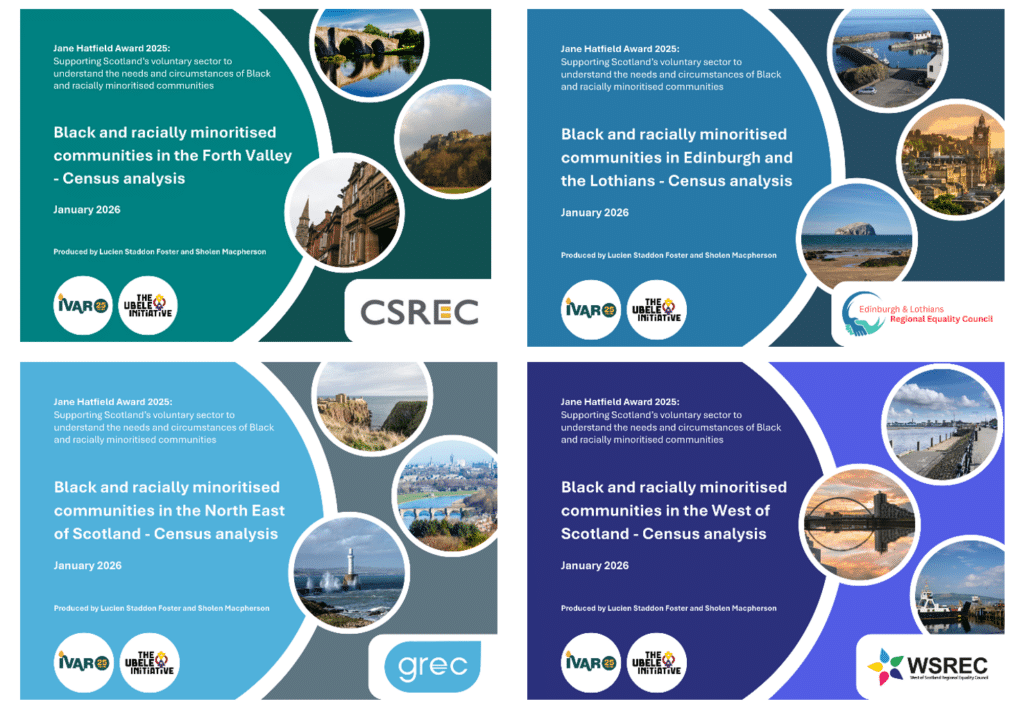
In total, these comprised over 250 pages of bespoke analysis, providing more than 200 charts and tables to capture the experiences of Black and racially minoritised communities, inform the design and delivery of services, and help organisations provide evidence to funders, policymakers and the public bodies they work with.
How our partners are using our work
In early 2026, we met with our partners and handed over our initial outputs. This provided an opportunity for our partnering organisations to share their thoughts, have any questions or concerns addressed, and share how these reports might help them support Black and racially minoritised groups in Scotland and the wider groups they work with.
Based on the feedback received, the project resoundingly delivered on its aims. It captured some of the critical issues around data and funding, and provided a solid foundation for organisations to better understand inequality in their local areas and utilise evidence-led approaches to service design, policy advocacy and funding.
The utility of this work is perhaps best captured in our partner organisations’ own words:
“This is a fantastic and invaluable piece of work. It is thorough, insightful, accessible and, most importantly, of practical use. The researchers have taken the time to understand what would be most beneficial to our work, focused this briefing accordingly and have been flexible and adaptable in the process. This type of analysis is essential for evidence-led work, but unfortunately, it is beyond the capacity and resources of our organisation and many others working in this sector. We have no doubt that this bespoke census analysis will significantly assist and improve the design and delivery of our community-based services.”
“I found the place-based focus particularly important, as without this level of local data, the experiences and inequalities affecting specific communities often remain hidden. Having this evidence strengthens our and other organisations’ ability to clearly justify need and respond in ways that reflect the realities facing Black and racially minoritised communities.”
“The report also provides a strong foundation for shaping targeted services and will be extremely useful for future funding applications. It will also support our wider work in influencing partners and stakeholders, and in challenging assumptions at policy and not grassroot levels.”
Beyond the operational implications, having access to this regional evidence was also seen as a positive, validating experience. This was, in part, because it provided clear, quantitative data to support what those working in the voluntary sector had observed, felt and believed about the communities they work with and support, but were not able to capture or evidence themselves.
“It reflects what we’ve known for a very long time”
“We’re not just saying things – it’s true”
“You know these things are real, but it’s hard to prove it”
While having access to this statistical evidence is clearly a positive outcome, its importance reflects a broader issue – the harsh burden of proof placed on Black and racially minoritised communities in order for their experiences of discrimination, disadvantage and inequality to be believed.
We hope that the quantitative evidence we’ve provided can not only validate people’s lived experience but also reinforce the types of evidence that are too often ignored and undervalued by those in power. If organisations can prove that people’s experiences are not anecdotal or arbitrary, but are representative of broader structural inequalities, we hope this can open new pathways for policy advocacy and the promotion of equality.
In closing
When designing this project, we wanted to challenge two key issues that we are all too familiar with as race equality researchers and anti-racism campaigners: the inaccessibility of high-quality statistics on the experiences of Black and racially minoritised groups in Scotland, and the knock-on effects this has on voluntary sector organisations when it comes to funding, policy advocacy and understanding inequality.
Supported by the Jane Hatfield Award, we have not only achieved our goals but have also directly supported some of Scotland’s leading organisations providing advice and advocacy services for minority ethnic communities. We hope that this has demonstrated the value that directly supporting the voluntary sector can bring, and has helped to exposed the challenges and barriers faced by organisations supporting Scotland’s Black and racially minoritised communities.
However, despite the positive steps we’ve taken, our project can only address the symptoms of a much more systemic issue. A project like this should not have to exist – instead, Scotland must significantly improve the quality, availability and coherence of its ethnicity data, and better empower the voluntary sector to access and use statistical evidence in its work. Funders can also play a crucial role here, in part, by recognising the disproportionate and exclusionary effects of the requirements for quantitative evidence and official statistics to prove service needs. Ultimately, as long as the experiences and outcomes of Scotland’s Black and racially minoritised groups remain marginalised in our statistical systems and evidence bases, inequality in Scotland can continue to be downplayed, denied and ignored.
Jane Hatfield Award Research
-
Publication
Collective Healing: The UK African Diaspora with Africa and the Caribbean
Read more: Collective Healing: The UK African Diaspora with Africa and the CaribbeanAcross the African diaspora, the legacies of colonialism, slavery, displacement and racial injustice continue to shape…
-
 Publication
“We can’t get the funding because we can’t get the evidence” – Supporting the Scottish voluntary sector’s work with Black and racially minoritised communities
Read more: “We can’t get the funding because we can’t get the evidence” – Supporting the Scottish voluntary sector’s work with Black and racially minoritised communitiesAcross Scotland, voluntary organisations working with Black and racially minoritised communities are operating under immense pressure.…
-
 Publication
Exploring experiences and barriers in seeking mental health support among male asylum seekers in hotel accommodations
Read more: Exploring experiences and barriers in seeking mental health support among male asylum seekers in hotel accommodationsAsylum seekers are often traumatised people who have already faced trauma in their country…
-
 Publication
“Let My Candle Shine” – Young Black Women Navigating the UK Voluntary Sector
Read more: “Let My Candle Shine” – Young Black Women Navigating the UK Voluntary SectorWorking in the voluntary sector poses challenges for everyone; it is a demanding path…
-
 Publication
Barrier after barrier
Read more: Barrier after barrier‘A report to understand and critically disseminate the barriers that racially marginalised young people…
-
 Publication
Social entrepreneurship as a reintegrative solution for ex-prison residents
Read more: Social entrepreneurship as a reintegrative solution for ex-prison residentsCan social entrepreneurship opportunities act as a viable avenue for 18 – 24 year…