
Across the funding sector, funders are showing a growing interest in collaborative, equitable and system-focused approaches. However, how such ambitions can be implemented is unclear, particularly when funders with differing mandates, constraints and interpretations of systems change work together. Bridging the gap between intent and implementation remains a challenge with important implications for the effectiveness of funding in addressing long-standing structural inequalities.
Propel represents a distinctive response to this challenge. Rather than operating only as a mechanism for distributing resources, it functions as a deliberate experiment in changing funding alongside funding change. Through its 10-year commitment to tackling London’s structural inequalities, Propel requires participating institutions to examine and, in some cases, disrupt their own established practices. It is valuable not only for its scale and ambition, but also for its openness about the complexity and tensions involved in efforts to shift entrenched power dynamics. As such, it is a compelling case study for funders seeking to translate systems change ideas into practice.
The ambition was to resolve an issue faced by the sector. Funders themselves couldn’t resolve that issue – the issue was too big for one organisation.” (Funder)
This report captures learning from the first three years of Propel (2022-2025), a cross-sector collaboration that brings funders, equity partners and organisations led by and for London’s communities together to tackle systemic inequalities. Drawing on interviews, workshops and shared learning between 2022 and 2026,1 it reflects on what it takes to fund and support systems change at scale and on how funding itself must change to make this possible.
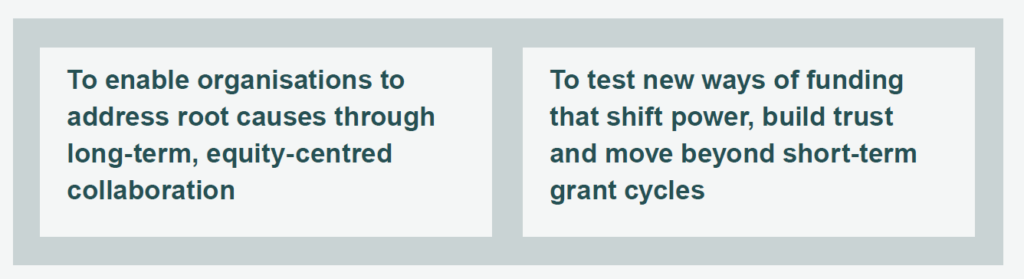
Propel set out with two parallel ambitions:
The learning in this report is intended to inform Propel’s next phase, from 2026 onwards. It also aims to contribute to wider conversations about how funders and civil society can collaborate to achieve lasting change.
Key Findings
1. Long-term, flexible funding is essential for systems change
Multi-year, flexible funding enabled organisations to move beyond short-term survival, providing the “headspace” required to reflect, build partnerships and engage with complex systems. Without this stability, organisations were often stuck in cycles of firefighting and delivery, limiting their capacity to think strategically or influence wider change. Longer funding horizons also legitimise planning, learning and relationship-building as fundable activity, challenging traditional assumptions about what constitutes value for money.
2. Systems change has no single definition
Partners understood systems change in very different ways. Funders oscillated between structural ambition and a desire to change their own bureaucratic practices, while funded organisations described it through more grounded lenses: sustaining communities, challenging power, preventing regression or shifting narratives. Many did not naturally use the language of “systems change” at all.
Most by and for led organisations are trying to change power systems. They might not call it systems change, so let’s not disregard those organisations because they’re not naming it.” – Equity Partner
Rather than resolving this through a single, imposed definition, Propel embraced a more flexible approach — ensuring that defining “systems change” did not itself become an exercise of power. A practical framework emerged with three interconnected routes: strengthening underfunded equity-led organisations, funding work that explicitly dismantles structural barriers, and linking frontline delivery to longer-term influence.
3. Equity cannot be reduced to numbers alone
Propel’s commitment to funding “led by and for” organisations showed the limitations of relying solely on quantitative thresholds such as board or staff composition. Data provided a starting point, but sometimes excluded deeply rooted community organisations or included organisations that met numerical criteria without demonstrating genuine accountability. Involving equity partners directly in assessment and decision-making improved the quality of funding decisions, grounding them in lived experience and contextual judgment.
There’s still a lot more work to be done to redress the balance of equity and power, but we are way further forward now, three and a half years later. I still find it really, really exciting.” (Equity partner)
However, this shift revealed tensions around “equity within equity” – friction emerged when organisations were held to different standards regarding intersectionality, or when equity partners were required to work closely with organisations holding fundamentally different standpoints. Systems change, the report makes clear, is inherently complex and sometimes uncomfortable.
4. Power sharing improves over time, but structural constraints remain
Propel made progress in shifting power, particularly through the involvement of equity partners in programme design and, later, funding decisions. By year three, equity partners played a central role in assessing Expressions of Interest for long-term grants, contributing to a strong focus on led by-and-for organisations within the long-term cohort.
At the same time, power sharing was constrained by funder governance requirements, pace pressures and limited resourcing for equity partners. Equity partners’ experiences ranged from optimism to scepticism, underscoring that shifting power is not a one-off achievement but an ongoing practice requiring sustained intent and investment.
5. Collaboration can help to change funder behaviour
Propel functioned as a systems-change intervention for funders themselves. Participation prompted changes in risk appetite, reporting practices, attitudes to advocacy and the willingness to fund long-term, flexible work. Collaboration led to creative approaches: City Bridge Foundation and The National Lottery Community Fund provided an additional one-year grant to those funded by the Greater London Authority, which could only offer two-year grants due to political and financial cycles.
Systems change is not solo work.” (Funded organisation)
However, the experience revealed limits to aligned funding models. Funded organisations’ experiences still varied significantly in their terms and expectations, making the system feel like a “funder lottery”. Pooled funding presents a significant opportunity for genuinely collective decision-making, consistency of practice and deeper power-sharing across partnerships.
6. Trust-based learning is an essential ingredient of funding for systems change
Instead of being done to, it was like: the power is yours to do something with.” (Funded organisation)
Traditional monitoring and output-driven reporting are poorly suited to the complexity of systems change. Propel’s move towards relational, conversational learning created space for honesty, adaptation and shared problem solving. This was particularly true when funders took responsibility for capturing learning rather than placing the burden on funded organisations. Learning was most effective when embedded in governance, properly resourced and supported
by an independent learning partner that held partners accountable to shared principles.
Overall, the report shows that it is possible to fund differently. Building a more effective and equitable funding ecosystem requires investment not only in shared financial resources but also in the infrastructure that enables collaboration to function well – shared learning, convening, and governance arrangements capable of holding tension, supporting adaptation, and sustaining collective effort over time.
Learning from the first three years highlights the importance of fully resourcing equity involvement, embedding learning to keep it active, and continuing to test and refine a genuinely pooled funding model. Propel has laid strong foundations, and early signs point to progress in changing systems from within. The findings also make clear that further shifts in power are both necessary and possible – and that the Collaboration Circle, a pooled fund bringing together funders and civil society to design, learn and make funding decisions together, is central to achieving that ambition.