In partnership with
Crisis responses are expensive and reactive. They begin only once significant harm has already taken place: a family has become homeless, someone’s mental health has collapsed, or a child has been taken into care. By then, interventions are at their most intensive and costly.
With public services under sustained pressure with Labour’s renewed focus on devolution and community power, moving resources upstream is a high priority. If successful, it could reduce avoidable harm and break the cycle of repeated crisis in our communities. So what does it take for funders play a meaningful role in to shifting money away from intervention and towards prevention?
Houda Davis, Senior Researcher at IVAR, spoke with Carolyn Sawers from Corra Foundation and Sam Creme and Sophie Richardson from Collective Futures – two funders taking prevention seriously – to begin answering that question. Their experience offers practical lessons for others seeking to move resources towards prevention.
About the Funders
Corra Foundation funds early intervention that provides long-term support for families before crises escalate, particularly in relation to poverty, drugs and alcohol, and the wellbeing of children and young people. Alongside an Open and Trusting approach to grant-making, Corra is exploring how to help rewire public services around prevention rather than fund parallel projects that disappear when grants end. It uses its relationships with the Scottish Government and other funders, together with place-based community work, to help independent grants act as a catalyst for shifting public spending towards holistic, long-term preventative support.
Collective Futures explicitly prioritises prevention over intervention, focusing on early childhood development. Its ambition is to invest early and close the disadvantage gap before problems compound later in life. It is developing an iterative model that supports trusted frontline organisations, while driving systemic change through partners with the potential to positively influence early childhood development – including funders, businesses, and policymakers.

The problem with prevention
In Glasgow, a local charity worker is contracted by the council to knock on a family’s door with a clipboard. Their statutory mandate is to check certain things around child protection and safety. But it is only because of an additional, flexible grant from an independent funder that this same worker has the time to put the clipboard down, listen to the family’s complex realities, and then build a bespoke, holistic plan with the support of their family workers.
The clipboard represents mainstream systems: statutory, compliance-driven, chronically time-pressured – albeit delivered by skilled, dedicated staff doing their best in difficult situations. What the flexible grant buys is time to take a more family-centred approach, which is more likely to benefit children in the long-term.
But this is a rarity: mainstream systems are trapped in an expensive cycle of crisis management and compliance, while deeper preventative work on tends to rely on temporary charitable grants.
Let’s be realistic: investing in prevention can be a tough sell – financially, culturally and politically – even where there is broad agreement about its value. There are several reasons for this. First, savings generated by early intervention often eventually show up elsewhere in the system: for example, a public health team may fund family support that prevents a child entering care, but social care receives the financial saving. Second, crises are more visible, easier to name and more likely to attract public, and therefore political attention. Third, prevention is difficult to evidence because it is nearly impossible to, for example, point to the person who did not end up in A&E because a community group helped them remain stable. Finally, prevention rarely fits short funding cycles. Its effects may take years to emerge (see for example the Institute for Fiscal Studies’ evaluation of Sure Start), while commissioners and funders are under pressure to demonstrate impact much sooner and therefore gravitate towards crisis services with clearer, immediate outcomes.
This makes it all-the-more noteworthy when a funder goes against the tide and turns their attention upstream.
‘Rich soil’ and sharing power
Collective Futures began its work by asking two questions: where is disadvantage most persistent at ages four to five, and where are relationships already strong enough – through trusted frontline organisations or engaged local authorities – for funding to make a difference? As its Chief Executive, Sam Creme, put it, the organisation was looking for ‘rich soil’:
We weren’t able to do the soil-building work ourselves, because that would take a much larger scale than we had available – so we were looking for places where our funding could help amplify existing strengths.”
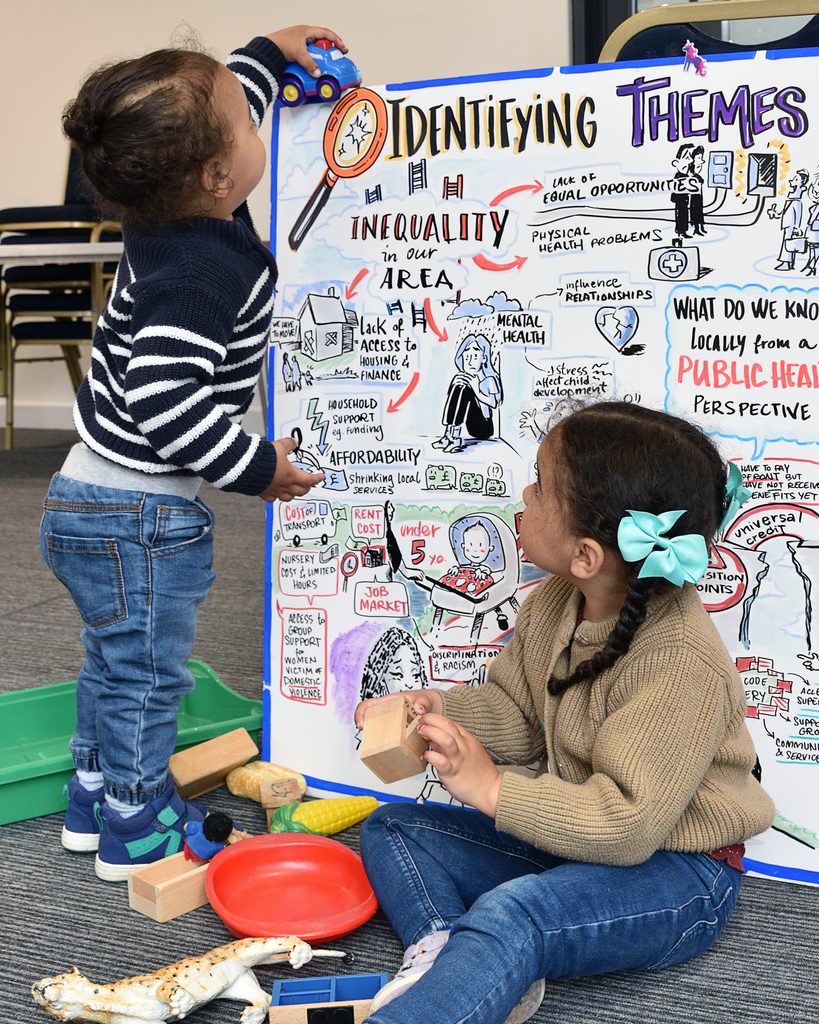
They landed on Barrow, in Westmorland and Furness, and North and East Cambridge, in Cambridgeshire. They worked with local organisations and public services to recruit paid parent and carer advisers who then shaped local priorities (see here for the local priorities and a video about the process with parents). Those varied: in Cambridge, financial barriers were more pressing, while in Barrow, improved access to community spaces and child-friendly activities were top of the list. Parental mental health came up as a leading concern for both communities.
Corra applies the same principle of resident-led decision-making. Its Methil Small Fish Fund handed grant-making decisions to local residents’ group Doon the Dam, while the Make it Happen Fund requires at least half of its decision-making panel to be community members with no professional stake in the outcome – in practice, it’s often 100% community-led. These groups often bypass safe, predictable options and make ‘very bold’ or ‘quite unexpected decisions’ that prioritise preventative support, says Corra’s Chief Executive, Carolyn Sawers:
In a previous programme I worked on, we ran a television vote and it was the elderly people in Edinburgh affected by HIV up against the children’s play park and we all thought the park would get most votes, and guess what won? It was the HIV service. Things can surprise you sometimes with that sort of boldness.”
The Scottish Government’s Promise Partnership panels have likewise funded work that is ‘quite systemic in its approach’, directing money towards strengthening the skills and approaches of people working within the system.
When residents choose together, they do more than allocate grants: they practise leadership, build relationships and strengthen the networks that prevent crises from escalating. Carolyn says:
The stuff that communities decide they want to do for themselves is the protective stuff…. It’s community groups that look after one another. It’s bottom-up wellbeing activities like walking, cooking. It’s community transport to help people be more connected.”
In both cases, communities are not merely identifying needs. They are naming the conditions that keep crises from happening in the first place. This rooted work gives funders the knowledge, trust and legitimacy to carry those insights into wider systems.
Flying two planes at once
Local work and structural change are not separate tracks. What funders learn alongside communities can shape public services; changes to those services should, in turn, improve everyday life in those communities. As Sam puts it:
The local ecosystems work informs our strategic projects by making them focused on the things that matter to people today.”
Corra sees the same loop at play. Deep work alongside communities shapes partnerships with the Scottish Government, ensuring more top-down efforts to build resilience are grounded in what communities value.

Prevention does not remove the need to fund crisis response. Funders must, as Carolyn puts it, ‘fly both planes at the same time’. Do the crisis work, but also think about the future. The real funding gap isn’t crisis services versus preventative ones. It’s the work of managing the shift between them – funders paying for the people and time to run one system down while building the other up.
Collective Futures are trying to bridge this gap at a place-based level. Grants aim to balance longer term stability with innovation through a £25,000 unrestricted core grant for three years, alongside more specific small pots including a £2,000 innovation fund and a £3,000 ‘catalyst grant’ to allow them to be responsive to families’ needs. Since one of their strategic projects is supporting talent development in the social sector, they are also putting that into practice locally – through a £3,000 leadership fund for each grantee, which can be used at their discretion to invest in their own teams, or pooled with others locally to do something bespoke in their community.
Partnership working: bending the mainstream
Corra recognised a fundamental dilemma for independent grant-makers: if they only provide short-term funding for charitable services, they risk creating a side system that disappears as soon as the grant ends. This approach leaves the mainstream statutory support entirely unchanged.
We can take a million pounds of funding… we can help 100 families… But if you can take the learning from that, and use it to influence what happens for every family in Scotland, your impact is far bigger.”
To genuinely move the dial on prevention, Corra intentionally focuses on how independent funding can ‘nest’ within mainstream support to fundamentally reform it.
Short-term [programmes] funded by a grant funder will always end, and so what you’ve got is a parallel stream that’s a wee bit better, and you’re not changing the mainstream support. That’s the fundamental realisation!”
Corra uses its position – as both an independent funder and a government funding partner – as a ‘magnet’ for public-sector interest and resources. Programmes such as the Way Forward for Families Partnership, jointly funded with the Scottish Government, require co-funding from local public-sector partners. This helps bend mainstream funding towards prevention rather than leaving preventative work in a separate, short-lived stream.
Public-sector workers are often trapped in rigid, reactive compliance modes, with little freedom to innovate. Corra helps overcome this by bringing public and third-sector partners together and explicitly declaring that they are ‘doing something different’. This creates a protective ‘bubble’ or framework: permission to step outside day-to-day pressures, learn with voluntary organisations and test preventative practice.
Money gets people in the room – Collective Futures is candid about this:
It’s a huge privilege of power that we can email people and they’ll show up because we’re coming with money. A really tangible way to use that for good is to bring people together who wouldn’t otherwise have the opportunity. Funders can pay for people’s time to be in spaces together, and we can think carefully about who’s included so those who might not normally engage can influence too.”
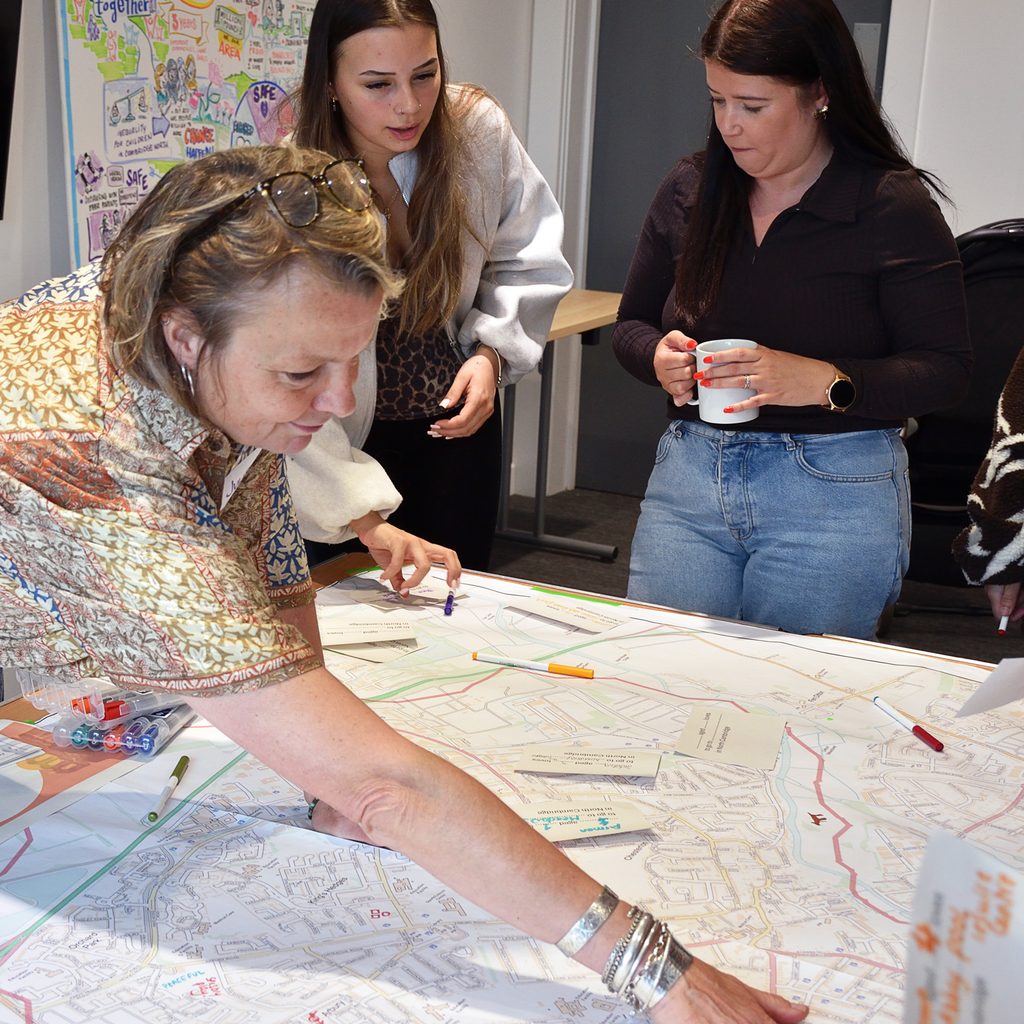
But turning that access into something useful took much more than an email. Before Collective Futures held any community meetings, a team member spent six months building relationships with local infrastructure organisations, including the Community Foundation, the CVS, Children’s Services and Public Health. It resources this through dedicated collaboration funding and innovation pots. Corra reaches the same conclusion: organisations cannot collaborate, learn and redesign services in their spare time. Funders can pay for staff time and participation, training, evaluation, facilitation and learning support.
This investment in relationships does more than enable collaboration: it also changes the way funding itself is designed and administered. When funders take time to understand organisations before awarding grants, they can replace burdensome application processes with more proportionate, trust-based approaches and provide the flexible, long-term support that preventative work requires.
We know frontline organisations value human, low-burden process over lengthy written applications. Collective Futures is also providing unrestricted, multi-year funding, which allows organisations to cover core costs, staff, systems and longer-term planning. This provides strategic headspace, which helps leaders move beyond immediate pressures and invest in the longer-term.
Sometimes bringing people together in a room can lead to instant preventative steps. Sophie Richardson, Head of Partnerships and Programmes at Collective Futures says, recounts the story of a mother at one of their workshops:
…one of the mums, her son was critically poorly in the first year of his life and ended up spending a lot of time in acute care in Manchester. When she came back to Barrow, she couldn’t take him to any of the classes locally because he was immunocompromised and she just didn’t feel like there was any safe space for him. At our workshop, the Family Hubs lead heard this and the next day she called and said, we’re putting on this special class… just for those children who have been hospitalised and need that kind of safer space to come together.”
This rapid response is an early sign of changed system behaviour: a public service listened to lived experience, adapted its offer and acted preventatively rather than waiting for need to escalate.
Understanding progress without pretending prevention is simple
Learning about prevention is notoriously difficult because, fundamentally, you are trying to understand something that does not happen.
Neither funder claims to have solved this challenge. Instead, both argue that funders should stop trying to prove a direct line of causation between a grant and a major systemic outcome. Sam says:
If the disadvantage gap doesn’t narrow… we don’t want to just say, oh, well, we failed… we want to be able to see what else have we managed to influence and impact locally…we’re not going to claim the disadvantage gap changes just because of us, but hopefully we contribute something towards it improving.”
They see themselves as part of an ecosystem, working in complex environments alongside other funders, public services and frontline organisations. Because people’s lives are complex, measuring change requires continuous learning, experimentation and adaptation. The focus should be on the long-term health and flourishing of the system, not only on short-term outputs.
Corra Foundation tracks change in several concrete ways. It looks at whether a greater share of funding is moving towards prevention rather than crisis response; it gathers evidence of protective factors such as peer support, community connection, confidence and access to help; and it listens to communities about whether these conditions are reducing risks before they escalate.
Collective Futures recognises their ultimate goal of narrowing the early childhood disadvantage gap may take up to 10 years or more to show results. To measure short-term change, their learning framework tracks the development of ‘enabling conditions’ such as the strength of local partnerships, relationship dynamics and how joined up the local system is becoming. And as Sam says:
It’s not just about what gets funded, but about how we’re working. So we’ll ask ourselves: is what we’re doing enabling communities to come up with their own solutions and are we doing our best to back them?’
Measuring change requires turning the lens inward, tracking how you’re empowering communities and engaging with the system. Corra Foundation looks at the proportion of multi-year, unrestricted funding they award – which gives communities flexibility to design their own responses. They also look at whether funded organisations are genuinely led by the communities they are supporting.
Redesigning funder practice for a preventative future
For funders serious about prevention, these experiences – alongside insights from IVAR’s own place-based and Open and Trusting work – point to three sets of practices.
Build deep roots and ground funding in place-based, community-led realities
- Find the ‘rich soil’: Be realistic about where your resources can add value. Look for places with trusted frontline organisations, committed public partners and strong local infrastructure.
- Let communities define prevention: Involve people with lived experience in interpreting the evidence and setting priorities – and pay them for their time and expertise.
- Share decision-making power: Use accessible micro-grants and community-led panels to put resources directly into residents’ hands.
Translate local knowledge into mainstream systems change
- Avoid creating parallel systems: Short-term grants can quietly leave mainstream statutory support unchanged. Design independent funding to ‘nest’ within mainstream systems, so that community knowledge and voluntary-sector practice help reshape what public services do.
- Turn local insight into a reform agenda: Use what families and communities identify as protective – from financial security and trusted relationships to mental health support and accessible local activities – to shape the priorities, design and practice of mainstream services.
- Use funding to help reshape mainstream practice: Seek co-funding where it can redirect public resources, while creating protected space for partners to test more relational and preventative approaches.
Convene communities and system leaders
- Bring families, voluntary organisations and public decision makers together: Turn grounded local knowledge and existing relationships into joined-up action, and fund the connective tissue – relationships, learning and collaboration.
- Pay for the groundwork: Trust and legitimacy take time to build. Budget for months of relationship-building with local infrastructure before beginning formal work.
- Fund the capacity to change: Resource facilitation, staff time, shared learning and dedicated collaboration or innovation funds.
- Make your funding behave like your values: Pair core support with flexible pots where local partners can have space to test ideas or act quickly.
- Coordinate with other funders: Share learning, identify gaps and overlaps, and co-fund where useful so that separate grants contribute to the same long-term shift
Conclusion: arrive gently and stay a while
If Corra Foundation and Collective Futures teach us one thing, it is that lasting change is built slowly through relationships and trust. As Corra Foundation has told us before: ‘Arrive gently. engage patiently. Stay a while.’ Prevention requires funders to stay close enough to communities to understand what conditions or factors keep people healthy, happy and connected, while working broadly enough with public systems to make those conditions durable. The alternative is the charity worker at the door with a clipboard, carrying out compliance checks because there is no time to do anything else. Prevention will not always produce a shiny outcome to report – no ribbon-cutting and no simple before-and-after picture. It is a long-term commitment to the relationships and conditions that allow communities to flourish.
Further reading
- Human Learning Systems: Public Services for the real world https://www.ivar.org.uk/publication/human-learning-systems-ebook/ provides examples, language and practice for shifting public service management toward learning, adaptation, and relationships instead of compliance.
- Six ways to move the dial on prevention – Future Governance Forum for a short provocation paper from the Social Insights Panel setting out six mindset shifts the government must adopt to achieve meaningful prevention, covering things like putting relationships and belonging at the centre of preventive work, focusing on people’s actual needs rather than institutional risk-aversion, valuing frontline practitioners properly, and overhauling commissioning culture to rebuild trust with community groups.
- Evaluating Prevention – Evaluation Support Scotland for a practical guide with step-by-step approach to tackling the classic prevention headache: how do you evaluate something that’s meant to stop a bad thing from happening in the first place?
- For support on planning and implementing place-based approaches see IVAR’s Place-based working framework