Evaluation Roundtable Convenings – February 2026
The February 2026 Evaluation Roundtable continued our exploration of trust-based learning, with a specific focus on enabling learning across roles: between charitable organisations and foundation staff, between foundation staff and boards, and among foundation staff playing different roles.
Our ability to achieve impact requires us to bring together wisdom from these multiple perspectives so that we can understand more fully the social challenges and systems within which we work.
- Funders need to learn from charitable organisations, who bring deep wisdom about the realities of the communities and contexts in which they work, what it takes to implement the work, and how strategies play out on the ground.
- Charitable organisations can benefit from the insights of foundation staff whose role enables them to see patterns in the challenges and successes of many different organisations working in different ways on similar issues.
- Foundation boards need strategic intelligence from staff and charitable organisations as they make decisions about strategy and resource allocation from a perch that is often some distance from the work.
Learning across roles should be open and connected, so decisions align and everyone shares a clearer sense of what it takes to create change. But this is isn’t always easy: each role works at a different level, with different responsibilities, time pressures, and comfort with uncertainty. Insights don’t always translate across the chain, and limited capacity makes it even more challenging. Honest learning is also constrained by the natural reluctance of charities, funders, and trustees to openly discuss challenges or setbacks with one another.
The three case study examples below provide an opportunity to examine what conditions and approaches make learning possible between foundation boards and staff, between foundation staff and charitable organisations, and across foundation staff teams in a way that can also be useful to the other roles.
Case Study Highlights
Balancing assurance and agility: The Robertson Trust’s Impact & Insights Framework
The Robertson Trust is one of Scotland’s largest independent charitable foundations, with a commitment to spend an average of £30 million each year to prevent and reduce poverty and trauma. For much of its history, the Trust operated as a responsive funder, awarding a high volume of relatively small grants across a diverse range of charitable organisations.
Its approach to understanding impact reflected this model. Learning was primarily relational and process-oriented, drawing on grant-holder reports, surveys, and ongoing conversations between staff and funded partners.
The adoption of a new 2020–2030 strategy marked a turning point. The strategy articulated a desire not only to fund good work, but to contribute more deliberately to shifts in the conditions and systems that shape poverty and trauma in Scotland. At the same time, the Trust was affirming a commitment to Open & Trusting grant-making (O&T), with a growing share of unrestricted grants reflecting a belief that impact increases when funders back organisations, not just projects.

FROM: The nature of the challenge
The Trust’s learning practices had grown organically and offered useful insight into grant delivery, but they no longer matched its wider ambitions around prevention and long‑term change. Existing processes struggled to reveal system‑level patterns, and board agendas left little room for deeper strategic reflection. A key challenge was agreeing what counts as credible evidence in complex systems: some trustees were used to clear metrics, while others worked in contexts where progress is relational and slow. These perspectives weren’t in conflict – they simply reflected different, equally valid ways of understanding accountability.
We all want to know whether we’re really making a difference. We just come with different instincts about what evidence gives us that confidence. I wasn’t looking for more data. I was looking for something that helped me understand whether we were learning as we went.’ (Trustee)
A second challenge was balancing the need for evidence and accountability with the reality that learning must help the Trust navigate uncertainty. Performance‑focused reporting often encouraged overly polished accounts of progress and discouraged staff from raising real challenges. Board members found these discussions unsatisfying, with too little insight to support meaningful governance. The same dynamic appeared in reporting from funded organisations: while information was good, it rarely revealed how to achieve results in a complex, shifting context.
‘We knew we were gathering good information, but nothing tied together in a way that showed what was happening across the system. We wanted something that helped us see patterns, not just activities.’ (Staff)
TO: The goal of the Impact & Insights Framework
To tackle these challenges, the Trust appointed Zoe Ferguson into a new Head of Impact & Insight role and Ferguson was charged with developing a more intentional framework and approach to evidence-informed organisational learning and accountability − its Impact & Insights Framework (IIF).
The IIF aims for a more coherent approach to learning − one that can hold multiple forms of evidence, support adaptive decision-making, and meet trustees’ needs for assurance without oversimplifying the work or adding more burden for funded organisation.
What the Robertson Trust tried: A framework to support accountability for results-oriented learning
Early attempts to build the Impact & Insights Framework focused on conceptual models, but these felt too abstract for trustees and didn’t translate into practical governance. In 2023, the Trust shifted approach, synthesising existing evidence across its portfolio rather than creating new reporting demands.
This first synthesis was valuable but overly broad, reinforcing that meaningful learning couldn’t come from large-scale aggregation. The Trust then adopted a new thematic model: each quarter, the Learning team curates existing evidence, tests it through collective sensemaking with grantholders, lived‑experience contributors, staff, trustees, and experts, and produces a focused thematic report for strategic board discussion. This quarterly cycle now forms the backbone of the Impact & Insights Framework, with public versions shared more widely.
The turning point was realising we didn’t need more data − we needed a better way to work with what we already had.’ (Staff)

What results the Robertson Trust is seeing
The IIF has created a disciplined but flexible learning rhythm, strengthening insight generation without adding reporting burdens for grantees. As thematic cycles unfolded, trustees gained clearer system‑level understanding and shifted from judging individual grants to exploring patterns, conditions, and strategic implications.
- Different evidence preferences found common ground through the mix of structure and qualitative depth.
- Staff moved from activity reporting to shared inquiry, using regular reflection to build confidence in navigating uncertainty.
- Funded partners described the collective sensemaking sessions as unusually candid and generative, with learning separated from funding decisions.
- Most importantly, the Trust developed a more realistic view of its own contribution, seeing its grants in context and grounding expectations in how change actually happens.
The conversation in the board room has shifted from “show us the impact” to “what does this mean for where we go next?”.’ (Trustee)
What the Trust has learned along the way
When learning is first [or more prominent] on the agenda, the conversation is completely different.’ (Staff)
As the Impact & Insights Framework has taken shape, the Trust has begun to develop a more settled understanding of what it means to learn credibly in the context of complex social change. Rather than producing definitive answers, the framework has helped staff and trustees clarify the kinds of questions worth asking, the role the Trust can reasonably play, and the forms of evidence that best support good judgment. Click to read more.
- The Trust has learned the importance of seeing its role within a wider ecosystem, recognising that progress on poverty and trauma prevention comes from many actors working together. Early attempts to pin down attributable impact placed unrealistic expectations on the Trust and discouraged honest reflection, reinforcing a performance‑driven culture rather than genuine learning.
- By shifting the focus from proving impact to understanding contribution, the Trust can better see how its funding, relationships, and convening power support partners within a wider system. Making other drivers of change visible has created a more credible sense of accountability and helped the Trust concentrate on the levers actually within its control.
- Learning works best when it’s built into governance. Trustees engaged far more constructively when learning was given real space on board agendas and framed as inquiry, not review. Clear roles – staff curating evidence, trustees sensemaking with partners, and external contributors linking insights to strategy – reduced defensiveness and encouraged curiosity. This shift in meeting design led to more open, generative conversations across different evidence preferences.
- Staff have learned that repeated cycles of synthesis and sensemaking help to normalise ambiguity as a feature of systems work rather than a failure of analysis. The regular cycle creates growing confidence in articulating hypotheses, surfacing tensions, and naming what remained unclear – supported by leadership’s consistent reinforcement that insight, not certainty, is the goal.
- Bringing grantees, lived‑experience partners, policymakers, and practitioners into collective sensemaking has deepened insight and enabled far more candid discussion of challenges and system pressures. By separating learning from assessment and carefully designing the space to reduce power dynamics, the Trust has created conversations that surface system realities traditional reporting rarely captures.
- Trustees who participated in these sessions noted the value of hearing directly from partners, not as subjects of evaluation but as co-interpreters of change.
- The Trust has learned that insight isn’t enough on its own. Each cycle produces more learning than can be acted on immediately, so staff and trustees now focus on prioritising a small number of key questions that merit governance attention. This discipline helps ensure learning shapes strategic direction without forcing premature decisions, keeping the Trust focused and responsive.

Looking ahead: Ongoing challenges and dilemmas
The Trust is currently focused on refining, stabilising, and embedding its IIF approach, continuing to build comfort with the inherent uncertainties of social change, and building tighter connections to ongoing strategic adaptation at both the staff and board levels. This includes:
- Right-sizing scope and effort: As the Impact & Insights Framework matures, the Trust is now focused on keeping insight deep without letting the process become too complex or burdensome. There’s a shared recognition that the discipline that makes the IIF valuable could, if over‑engineered, slip back into old habits of more data and reporting rather than genuine learning.
- Connecting insights to action: Synthesised insights don’t always point clearly to next steps, leaving the Trust to judge whether they signal action, further inquiry, or simply reflect ongoing system conditions. Some staff still experience the IIF as slightly removed from their own work, highlighting the need to better integrate the process into team‑level decision‑making rather than seeing it mainly as a tool for trustees.
- Stewarding through turnover: The relational nature of the IIF needs continual care, as trust, psychological safety, and shared purpose must be actively maintained as people and roles change. These challenges aren’t flaws in the framework but part of sustaining a learning organisation. The Trust’s ongoing task is to balance assurance with agility, clarity with complexity, and strategic intent with humility, keeping learning central to how it understands and contributes to social change.
How the Impact & Insights Framework Works in Practice
The Impact & Insights Framework (IIF) developed gradually as the Trust sought a learning approach that could keep pace with the complexity of its strategy. Rather than beginning with tools or templates, the framework emerged through a series of practical questions: how to make better use of existing knowledge; how to surface patterns across diverse work; and how to support governance conversations that were both rigorous and realistic.
As one member of the Learning team reflected, ‘We already had the information – we just weren’t learning from it systematically’. The IIF was designed to change that.
The Impact & Insights Framework is not a fixed model. It is a living system that continues to evolve as the Trust learns more about its own role and the systems it seeks to influence. What distinguishes the IIF is not any single tool or method, but the way it combines disciplined synthesis, collective interpretation, and governance-focused reflection into a coherent whole.
Continuous learning governance at Carnegie UK
Carnegie UK is a policy-focused foundation dedicated to advancing collective wellbeing and achieving large-scale systemic impact by putting wellbeing at the heart of government decision-making across the UK and Ireland. While pursuing this extensive mission, the foundation operates on a relatively small scale. Its endowment is not enormous; its annual budget is limited, and it carries a low-risk profile because it is not delivering statutory services or financing critical services, functions or organisations.
The team acknowledges that attempting to achieve very big things in the world within these constraints requires an adaptive approach. The work itself is complex, non-linear, and based on a theory of change − that better policy decisions will follow if governments adopt wellbeing models – which contains big evidence gaps. Progress is consequently difficult to define.
The nature of the challenge
Carnegie understands impact as contributing to systemic change in public policy, not claiming attribution. Its independence allows it to focus on improving strategy rather than proving value through KPIs. However, traditional governance structures – heavy board papers, proliferating KPIs, and a culture of low trust – had over time created anxiety and performative reporting. Staff behaved as though the Board was risk‑averse, even though it wasn’t. Governance was further strained by a long‑standing structure in which half the Board came from a local grant‑making trust, creating uneven expertise and unclear purpose. By 2021, leadership recognised the need for a full governance reset, aiming to move from KPI‑driven oversight to a model of continuous learning governance.
The role of the foundation is to be the intelligent actor and convenor in this system, continually using feedback to improve our strategy, rather than attempting to prove our value through linear transactional models.’
The goal of continuous learning governance
The foundation defined its shift by framing governance as being ‘continuous and
generative rather than static and performative’:
The goal was to build a board that was more holistic, more curious, more constructive, and to harness the varied experience and perspectives of its trustees.’
The purpose of the board was redefined, non-traditionally, as:
To review progress against aims, consider what has gone well and less well, and adjust the delivery of the strategy in the light of this intelligence.’
This had the effect of refocusing accountability away from linear performance metrics toward shared reflection, allowing the organisation to move ‘away from proving to improving’. Since the foundation operates with its own endowment, the core priority became internal:
Not to prove to anybody else that we’re having an impact, but to focus on
making that impact greater and better.’
Consequently, the trustees’ formal responsibility for programme governance has shifted to assuring themselves that the executive is learning about what it takes to achieve impact and is acting on that learning. This new purpose centres on the shared journey and the commitment to shared learning.
What Carnegie UK tried
The commitment to learning governance was embedded through intentional cultural shifts and practical structural reforms.
The first critical element was establishing the principle that trustees are experts in the strategy:
This approach aimed to cut through the asymmetry on the board by levelling expectations and making clear to new joiners that you don’t need to be a policy wonk, you need to be an expert in our strategy.’
This provided essential coherence and purpose.
Secondly, to ensure the new learning approach was visible to trustees, the organisation changed its papers and meeting structure. Staff papers and the CEO report are now consistently organised as a reflective learning cycle: What/So What/Now What? This structure is fundamental, as the ‘So what?’ section forces reflection about what is being learned (rather than what has happened), and the ‘Now what?’ outlines how the findings contribute to the established strategic objectives for the work.
Thirdly, the board agenda was redesigned to put shared reflection first, with a dedicated hour for ‘Shared Learning Discussions’ that mixed trustees and staff in small‑group inquiry. These sessions vary in feel but have increasingly been used to explore external intelligence and frame the whole meeting around strategic learning. Significant Moment Reports now support this process by bringing key reflections to the board at pivotal decision points.
Fourthly, the organisation also increased points of engagement outside the main meeting, including experimenting with the involvement of trustees in occasional ‘Programme Assurance Meetings’ and internal webinars. The transition into this model relied heavily on building a specific culture:
It required establishing mutual respect and being on a shared journey, where staff could share puzzles and throw ideas out without fear of being closed down. The model embraces the uncertainty inherent in systemic change, operating with the mindset that if you hit the edge or the side, or something goes wrong, well, then you learn.’
How this has landed in governance at Carnegie UK
The implementation of learning governance has delivered benefits, primarily in fostering a healthier, more aligned organisation:
Perhaps the biggest gain is that conversations now align better with our values and our understanding of how change happens, resulting in a system that feels congruent.’
Board reflection increasingly centres on two questions: what the organisation is learning about collective wellbeing, and what it is learning about creating change. This has begun to shift dynamics between staff and trustees toward more equal, generative inquiry. Moving away from traditional metrics has created anxiety for some staff and newer trustees, who worry that learning may not translate into visible progress. This is compounded by the organic nature of policy work and recent organisational flux. Staff do not always find it comfortable to share disappointments and failures openly with the Board, and some learning tools risk becoming rote, creating the possibility of slipping back into performative behaviours.
What Carnegie has learned along the way
Maintaining a dynamic learning model requires sustained effort. A core lesson is that intentionality is crucial:
Leadership must provide the drumbeat of naming it and renaming it and reminding people what you’re about to do because the whole approach can drift if it is not made explicit.’
Conversations need to be actively anchored in the strategy:
To ensure discussions are productive, they must be dragged back down to earth in a practical and pragmatic sense. We need to become much more focused on where the generative learning conversations happen (e.g. around the strategy route map) and not try to be too sophisticated with the rest of it.’
A second lesson involves the nature of challenge. While the collaborative culture is strong, practice still lags a little behind:
There can still be a random chucking of stuff on the table in Board conversations, some of it useful and interesting, lots of it not; and without sifting and prioritising this material, no-one really knows what has landed and what’s not, and staff go away a bit confused.’
So, despite progress, there remains a sense that the generative process needs to land somewhere: ‘moving beyond lots of hot air to subsequent decisions about what happens next: trustees need assurance that there is substance to the learning discussion, that it lands somewhere’.
What Carnegie is grappling with now/anticipating next
The foundation is currently focused on refinement, seeking to solidify accountability and measurement without losing the generative benefits of the approach. Action is required in four areas:
- Refining Accountability
- Balancing Measurement
- Enhancing constructive challenge
- Clarifying decision points
Trust-based learning with partners at the Maitri Trust
Based in Edinburgh, the Maitri Trust is dedicated to improving primary education for children in India and South Africa. Providing flexible funding, Maitri partners with changemakers who share their mission to unlock life-changing learning for every child.
In November 2024, Maitri gathered with its South Africa partners in Cape Town to delve into the deep-rooted issues that face South Africa’s education system and explore how, as a community of organisations with a shared goal, they can catalyse change together.
The nature of the challenge
As a learning organisation, Maitri has always created spaces for internal reflection and learning, with the team meeting regularly to share insights from narrative reports and conversations with partners. These are valuable sessions, informing decisions about what and how to fund. The board also plays a key role in internal learning, and over recent years Maitri has built in more opportunities for learning through reflective conversations at board meetings, often bringing in partner voices. Maitri has also prioritised board member and funder learning through partner visits, which have provided direct experience of work on the ground, further enhancing board discussions.
Learning activities were geared towards making the best possible funding decisions, but as an organisation with a strong belief in collaboration, Maitri wanted to explore how they could deepen learning with and between partners to bring about more meaningful change:
Up until then, our learning had been very much about looking inward … Were we funding the right things? Were we working in the right way? But [we weren’t] thinking about sharing our learning. And it occurred to us, well, actually, this could be really helpful for other partners, but also the sector.’
In 2021, Maitri launched a survey of partners – the first comprehensive feedback survey for the organisation. The survey was followed by focus groups, bringing grantees from India and South Africa together. There was positive feedback from this process beyond the survey itself: partners said it was the first time they’d ever been in a space like this together, and they really appreciated it. This was a clear signal that partners wanted Maitri to help bring people together to share learning. For Maitri this reflective exercise also ‘threw open a lot of areas of improvement when it came to learning and communication’. In particular, how could Maitri amplify partners’ work, and ensure that information flows better within the organisation, and between partners, as well as the wider sector. Maitri also saw an opportunity to deepen its understanding and engagement with the contexts in which partners are operating.
Aim: To learn differently with partners
Maitri wanted to convene partners but waited until they had a clear mandate, using survey feedback to shape the timing and purpose. They aimed to create an intentional space for shared learning about system‑level opportunities and challenges. With their bird’s‑eye view of the sector, staff hoped convening would surface insights that often go unshared, highlight collaboration opportunities, and strengthen a sense of community among organisations working in the same space.
What Maitri tried: Convening partners in South Africa
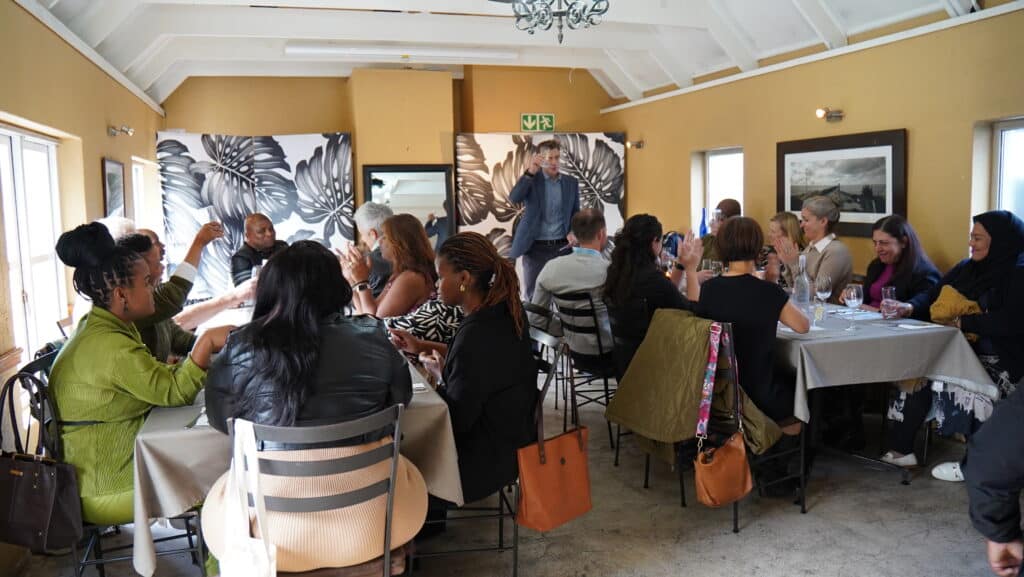
Maitri was keen to convene partners but wanted to ensure the format genuinely reflected their interests and added value. Trustees helped sharpen the purpose, prompting staff to design an agenda focused on shared challenges, collaboration barriers, and system‑level opportunities rather than organisational updates. A pre‑event questionnaire shaped the core topics — government engagement, systems change, and wellbeing. The November 2024 convening brought together senior representatives from all 14 South Africa partners, Maitri staff, and one trustee, with careful attention to logistics to create a relaxed, open environment. Covering travel costs, choosing a thoughtful venue, and hosting an informal dinner the night before helped build trust and connection.
The agenda was curated by the team in partnership with a carefully appointed local expert
facilitator, described as ‘one of the best decisions we made’:
She took the time to get to know Maitri, read the partner feedback to help curate well thought through sessions and was meticulous about everything from the tone of the day, right down to snacks!’
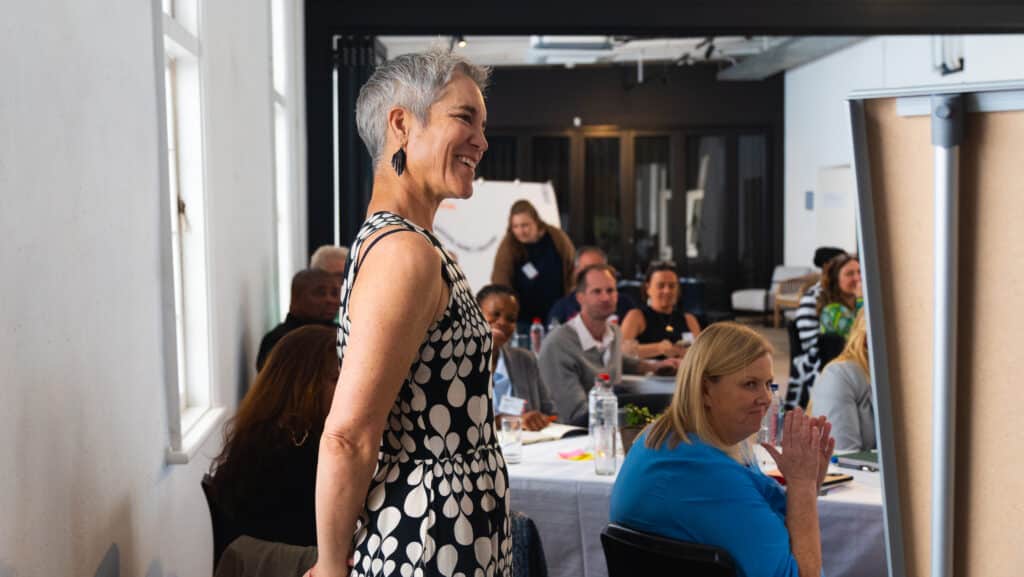
The facilitator’s approach created strong connection between Maitri staff and partners, blending expertise with empathy and using creative methods that suited different learning styles. Maitri staff were intentional about addressing funder–grantee power dynamics, showing up as active participants rather than observers and modelling vulnerability to signal they were there to learn. This helped create a balanced, open atmosphere.
The day began with a light, personal warm‑up before moving into a session on working effectively with government and scaling. A partner‑led panel, shaped by pre‑event feedback, enabled deep discussion about enablers and barriers to system‑level change.
The afternoon focused entirely on wellbeing, acknowledging the intense pressures organisations face. Although staff initially hesitated to include it, the facilitator encouraged them, and the session proved valuable – offering practical tools and giving partners space to discuss an aspect of their work funders rarely ask about.
The atmosphere and the engagement throughout the workshop were described as ‘vibrant’. There was serious discussion, but also laughter and singing:
We laughed. We sang. I mean, this is South Africa! There was a lot of joy, a lot of reflection and a lot of learning.’
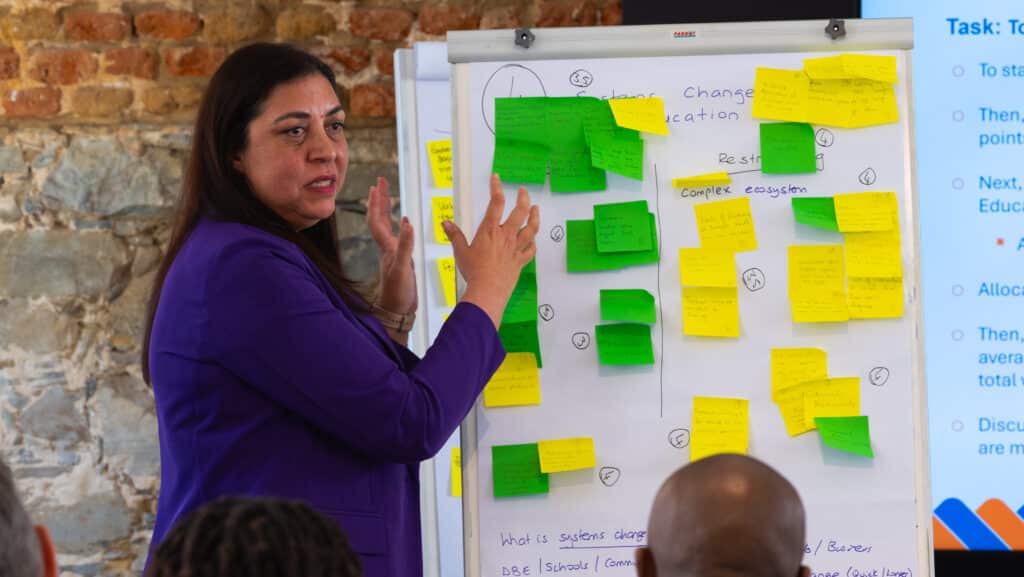
The day concluded with presentations, with each partner sharing a ‘Rose, Thorn, and Bud’, which included one challenge for Maitri. This mechanism ensured that Maitri received tangible feedback for future action. A visual illustrator captured the discussions, providing an accessible record people really appreciated and allowed Maitri to share information in a more creative and dynamic way. After the event, Maitri sought feedback from partners. They published a blog, shared their insights from the day, alongside a short video.
What results Maitri is seeing
The workshop was definitely worth all the hard work and planning that went into it:
It was the absolute highlight of … 2024 for everybody involved from Maitri’s side. It was the most special opportunity to really engage with people.’
It provided Maitri with more confidence to play a convening role in the future. The event and the subsequent learning were seen as an evolution of what was already happening at Maitri – more focus on shared learning with partners rather than internal reflection, and with more intention. It helped Maitri to strengthen a sense of accountability to funded partners and demonstrated a commitment to supporting partner-led learning and systemic change in the education sector. The learning generated quickly filtered into the foundation’s decision making:
The workshop fed into our refresh of Maitri’s theory of change and monitoring framework. The conversations about systemic barriers helped us think about indicators and partner engagement.’
The discussions also gave Maitri clarity on a key strategic question about its role in government engagement, resolving internal grappling on the issue. The explicit takeaway was that Maitri’s function is about ‘supporting partners to do that work well’ and ‘to elevate the work they’re doing through our own communications’, rather than Maitri trying to step into that role or space itself.
The relationships strengthened at the workshop enhanced trust, giving Maitri the confidence to share the new framework with partners and ask for honest feedback before rolling it out:
It definitely challenged us and our thinking … And that’s led to some changes, not directly, but it’s informed some of our thinking in how we monitor and evaluate partners and also changes that are coming down the line in how we’re going to be funding.’
In summary, the convening helped partners spot overlaps in their work, revealing shared challenges, similar initiatives, and opportunities to collaborate in the same schools or systems. This gives Maitri a chance to better connect its portfolio and strengthen impact through those crossovers. At the same time, learning with partners remains challenging, especially given the intense pressures of working in South Africa’s education system, where senior leaders and teachers carry heavy emotional and practical burdens.
Maitri is continuing to consider how best to support partner wellbeing and reduce stress. Although the workshop built community and goodwill, the sector remains competitive and traditional funding models can hinder collaboration, so Maitri is still exploring how to help partners engage meaningfully with one another.
At IVAR, we champion learning as a driving force for foundation strategy and practice through the UK Evaluation Roundtable. We believe that making good grants and investing in learning are not alternatives – they go hand in hand. Find out more here.