As we publish our 2026 Funding Experience Survey, Ben Cairns reflects on a survey that tells two stories – from the deeply sobering emotional toll on charities to the positive effect of Open and Trusting grant-making.
A Dark Word Cloud
Exhausting, soul-destroying, demoralising. This is how people in charities sum up their experience of fundraising.
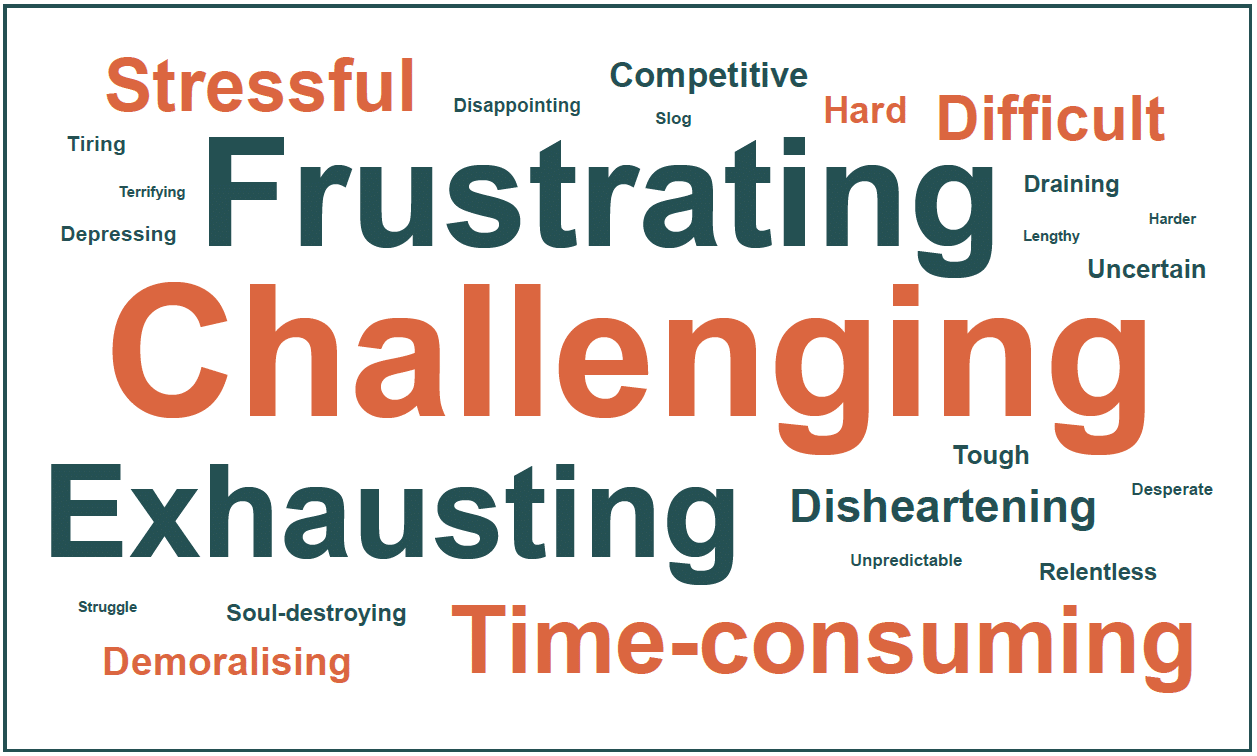
When asked for a word that encapsulated their experience of applying for funds, 81% of the 1,200 people who completed our 2026 Funding Experience Survey chose a negative adjective. Challenging, difficult and frustrating came up on top. Some went further: applying for funding is ‘the professional equivalent of banging your head against a brick wall for eight hours a day’. Like ‘trying to run up a descending escalator’ or ‘scanning an ocean for a single life raft’.
Should this be surprising? Funders’ resources are finite. This is not a game of pass the parcel, where everyone comes out with a prize. Rejection is part of the territory.
But second guessing, submitting weeks of work to silence, watching the goalposts shift halfway, applying for something you have no chance of getting in the first place, grappling through opaque decision making – these things shouldn’t be normal. And yet for many they are. Put simply: this is not okay. If we are seeing this much stress and distress in a job that should feel purposeful and rewarding, something is going very wrong.
A Surprising Silver Lining
And yet – another story also came out of our survey.
When asked, 51% said that applying for funding had got better in the three years since our last survey.
I don’t want to overstate things here. Only 9% said practices had improved a lot. And 28% said things had got worse. Things being better might still leave them sub-optimal. But still – this is a figure that might surprise people. It certainly surprised me.
Have funding practices improved, stayed the same or got worse over the last three years?
Source: Searching for Life Rafts: The Funding Experience Survey 2026 | ivar.org.uk
When you look closer at the 51%, this is made up of people who are also more likely to have experienced practices from funders – from publishing eligibility criteria to accepting changes to plans and budgets – that map on directly to the eight Open and Trusting commitments.
The more of these practices people experience, the more positive they are about their overall funding experience.
The more Open and Trusting practices charities experience, the more positive the funding environment feels
Source: Searching for Life Rafts: The Funding Experience Survey 2026 | ivar.org.uk
| Number of O&T practices respondents are experiencing | All respondents | No, they have got worse | Yes, they have improved a little | Yes, they have improved a lot |
|---|---|---|---|---|
| 0 to 5 | 44% | 66% | 37% | 12% |
| 6 to 10 | 43% | 30% | 51% | 47% |
| 11 to 15 | 12% | 5% | 12% | 41% |
This is, we believe, no coincidence. Nearly 200 trusts and foundations across the UK have now joined Open and Trusting, committing to adapting their behaviours and practices so that charities can do their best work. That means clearer processes, better communication, more timely decision-making. For 51% of respondents at least, these changes were noticed and appreciated.
The Flexible Funding Gap
But there is enormous variety in what charities experience. While many of the practices they value most are becoming common, many – clarity over reporting, accepting existing reports – remain rare. Most troubling is that the practices charities feel are most transformative – flexible funding: unrestricted and multi-year – are the least commonly experienced.
How far do funders’ current practices align with what charities say matters most?
Source: Searching for Life Rafts: The Funding Experience Survey 2026 | ivar.org.uk
This gulf matters. Flexible funding allows charities to hire staff on proper contracts, to plan beyond the next twelve months, to invest in their infrastructure and people. It is, in the words of one respondent, ‘gold dust’ – providing stability that makes strategy possible and allows organisations to, in the words of another: ‘focus on the people and communities they exist to serve’.
Under Pressure
Charities are especially in need of that security now. The pressures bearing down on the sector are profound: 89% had been significantly affected by at least one major pressure in the last year, and 50% had been significantly affected by five or more simultaneously.
The pressures affecting charities today
Source: Searching for Life Rafts: The Funding Experience Survey 2026 | ivar.org.uk
As the operating environment becomes more difficult, and in the face of political and economic upheaval there is a danger that funders – also affected – will retreat into less open, more restrictive practices. In the US, our partners at Trust Based Philanthropy Project talk about funders responding to the current climate by pausing to review, quietening their voices, withholding support at exactly the time they are most needed.
We believe that the Open and Trusting grant-making community – with its commitment to empathy, shouldering more risk, and being attuned to the needs of charities – can be an antidote to that risk.
If you are concerned about where the sector stands today – and asking what more you can do – please read the full report. The word cloud on page 18 is sobering, but perhaps we can, collectively, make it less dark.
For the last words, I’ll leave it to one of our respondents:
What difference would an Open and Trusting approach make to our organisation? A stronger, more resilient charity. Staff who can focus on support rather than survival. Services that are consistent, reliable, and high-quality. The ability to innovate instead of firefight.