In partnership with
AI is helping to generate an unmanageable tide of grant applications, with technology in turn being relied upon for assessments. But what if, instead of trying to automate our way out of demand, we thought radically about the purpose and design of the application form? Even using AI to create a more human experience? We brought funders, charities and technologists together to come up with bold plans for a post-form future.
AI is changing grant-making fast. Funders are seeing far more applications, and far longer ones, than ever before. That’s straining a system already stretched thin – and raising a harder question underneath it: when a polished application can be generated in seconds, how do you still find the organisation, and the idea, that AI can’t fabricate?
IVAR, the Centre for the Acceleration of Social Technology (CAST) and the US-based Technology Association of Grantmakers (TAG) partnered to convene a design studio to explore that question directly. We brought together 27 leaders from funders, charities and technologists around a single provocation:
“In the age of generative AI, the form-based application process is broken.”
Their task was to pitch prototypes – using AI or not – that respond to five persistent challenges in grant-making:
- How do funders define, find, and become findable by the best candidates – especially those not visible in existing data?
- How can we use data to inform robust decision-making at every stage?
- How might we embed trust-based learning throughout the experience?
- How can data help us identify and prioritise strategic needs and hotspots?
- How do we ensure funding decisions are inclusive and equitable?
What follows is a short summary of four prototypes born from that day. They’re a rapid design response, not a finished blueprint – some are radical, some could be piloted with nothing more than a change of mindset. None of them hold all the answers. But together they’re worth reading as an invitation: to treat the application form not just as a casualty of AI, but as a place where grant-making practice actually has room to change.
Prototype 1 – Grants for the greater good
What it’s trying to achieve: A fairer route to funding for grassroots and under-resourced organisations, who often lose out in competitive processes not for lack of good work, but for lack of experience writing bids and building relationships with funders.

How it would work: Applications go into an AI-supported system that screens for due diligence, then strips out identifying detail before a human panel sees anything. Personal data stays on file for eligibility checks, but what reviewers actually assess is de-personalised – reformatted to present the substance of the idea, not the polish of the writing. Because content is separated from authorship, applicants could submit in any language, removing a barrier that has nothing to do with the quality of the work.
Human judgement stays central throughout. Panels would be demographically representative of the community the funding serves – or, in one variation, made up of applicants themselves, reviewing each other’s proposals with the insight that comes from doing the work, not just reading about it.
Worth trying? Even without the AI layer, some funders are already experimenting with anonymised or de-identified shortlisting at early stages – worth watching what that does to who gets through.
Prototype 2 – AI avatars
What it’s trying to achieve: Give small, community-rooted organisations – ones with deep local knowledge but little capacity to write, pitch or market themselves – a way to be heard without first having to get better at applications.
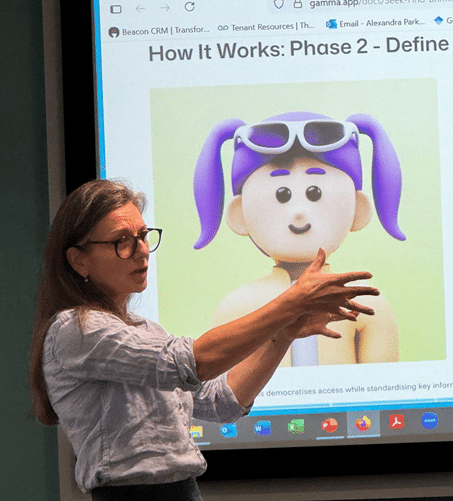
How it would work: There would be three moving parts.
- A shared database on a given issue, built once from grantseekers’ input, so no one has to repeat themselves across ten different funder portals.
- An AI-generated “avatar” for each organisation that can present and answer questions on its behalf – a stand-in for capacity that smaller charities don’t have to spend on pitching.
- An AI tool that lets funders interrogate the database directly, asking questions of the material rather than reading through it cover-to-cover. A crowdsourced, democratic layer lets participants vote on which solutions rise to the top, with deliberate outreach to the smallest organisations to keep the process genuinely representative.
Worth trying? This is the most technically ambitious of the four, but a smaller first step doesn’t need any AI at all – a shared, funder-agnostic profile that organisations complete once and any funder can draw on.
Prototype 3 — Fund match
What it’s trying to achieve: cut the duplication that eats up charities’ time – filling in broadly the same information for every funder they approach – by creating one place where that information lives, and funders come looking.
How it would work: A central repository holds organisations’ details, projects and funding needs, submitted just once. Funders search against their own criteria, reviewing key information before deciding whether to pursue a conversation, rather than sifting bespoke applications from scratch. A QR-style link lets organisations point back to their own websites for anything the repository can’t hold. Because the data is centralised, it also does something individual applications never can: it shows funders where the real gaps sit, by geography or by issue.

Worth trying? The barrier here isn’t the technology, it’s adoption – this only works if enough funders commit to using a shared repository instead of their own bespoke forms. Worth raising in funder networks and consortia as a genuine “who’s in” conversation, rather than something one funder builds alone.
Prototype 4 – Spaces of learning
What it’s trying to achieve: Move decision-making itself out of a form assessed privately by funders, and into a shared conversation where funders, charities and public agencies define both the problem and the response together.
How it would work: There’s no AI in this prototype at all, and that’s rather the point. Picture something closer to a learning conference than an application round: funders and grant-seekers convene around a specific issue, and the gathering itself becomes the mechanism for deciding what gets funded – replacing the written application entirely. Participants would be compensated, partly to correct the imbalance where funders’ time is paid and applicants’ time usually isn’t. Out of that shared exploration comes a shared judgement about what’s working, what’s missing, and where money should go next.

Worth trying? You don’t need to reinvent a whole funding round to test this. One issue-based convening run alongside your normal process, and a look at what surfaces differently, would tell you a lot.
Redesigning the form – or the relationship?
Some of these prototypes are radical, needing the latest in technology. Others could be piloted tomorrow with nothing more than a shift in mindset. Look past the differences, though, and one thread runs through all five: those closest to the problem are rarely the ones defining it.
That’s the real barrier this design studio surfaced. Application forms, review panels and eligibility criteria aren’t neutral instruments. They express who gets to decide what the problem is, and therefore what – and who – counts as a solution. When that power sits with funders alone, even the best-designed process keeps missing the people with the deepest insight into the need.
When that power sits with funders alone, even the best-designed process keeps missing the people with the deepest insight into the need.”
AI sharpens this, but it also opens a door. The pressure most funders feel first is volume – more applications, longer ones, harder to tell apart – and it’s tempting to treat that as a filtering problem: better screening, faster triage, more automation on the funder’s side of the form. But there’s a risk here that’s easy to overlook. If AI can smooth every application into the same confident shape, the form stops doing the one thing it was meant to do – letting an organisation’s own distinctiveness come through. Get better at processing applications that all sound the same, and you haven’t solved the problem, you’ve just industrialised it.
That’s really the invitation in these prototypes. None of them ask “how do we make the form more efficient?” They ask a different question: what if the form isn’t the right unit at all? What if the thing to redesign isn’t the document, but the relationship it’s meant to stand in for?
None of this is prescriptive, and none of it needs a full system overhaul to start. A funder curious about any of the above could pilot a piece of it alongside their existing process and see what changes. Co-creating the questions, not just the answers, is the whole point.
The irony is that in a world where AI can make any application sound accomplished, the organisations worth funding may increasingly be found by the routes that have nothing to do with the form at all. Where the human voice – however bumpy, idiosyncratic or flawed – holds even more persuasive power.
We continue to examine how AI is changing grant-making, and how it might be harnessed to support trust-based philanthropy. If you’d like to find out more, you can read about the AI Exchange, join the AI for Grantmakers peer group, or follow the conversation in the US.
This article is part of a new thought leadership series supported by Collective Futures, a new foundation interested in amplifying inspiring stories and sparking honest, practical conversations about what more open and trusting grant-making can look like.